
Highland County Criminal Docket Searches
The Highland County Clerk of Courts sends Common Pleas users to eAccess. The tool is also called Court View Public Records. That official docket search covers Common Pleas Civil, Criminal, and Domestic cases. So a felony belongs under its Criminal category. Ohio has no single statewide screen for every local trial-court docket. Begin instead with the court level. For lower-court cases, add the location tied to the matter. Have the exact case number ready if you can. The public General Division schedule shows a neutral criminal pattern of YYCR####. No number on your paperwork? Use only the search choices the official portal actually displays. Check the court division and case style on the result before opening the docket. Do not assume a particular name, date, or attorney field exists on the search form.
- Identify whether the case belongs in Common Pleas, Hillsboro Municipal Court, or Highland County Court in Greenfield.
- For a Common Pleas felony docket, open Court View Public Records from the Clerk or court route.
- Enter the known case number or use the current official search option that best matches the case information.
- Confirm the division, then read the docket in date order for the newest court-approved event and the next setting.
- Call the owning clerk or court for a filed image, certification, or a result that is incomplete or absent online.
Note: A shared name alone cannot identify a case. Confirm the court division and case details before relying on any Highland County docket entry.
Highland County Criminal Docket Images
What the Highland County Common Pleas docket gives the public is a list of events. It is not a library of documents. The Clerk states plainly that no document images exist online. So a docket entry can say a motion, order, or notice was filed. The paper itself cannot be pulled from a website. That gap proves nothing about withholding by the court. It simply marks a limit. The Clerk's legal office becomes the way to get a copy.
The Clerk contact information places the legal office at 105 North High Street, P.O. Box 821, Hillsboro, Ohio 45133, reachable at 937-393-9957. Doors are open weekdays from 8:30 a.m. to 4:00 p.m. Ask for a record by naming the court and the case number. Give the rough date and the type of filing you want. Under Local Rule 1, a Common Pleas proceeding costs $5 as a digital copy. A typed transcript goes through the separate reporter process the rule describes.
One more tool needs sorting out. The Highland County Clerk case-management-system e-filing function serves filers, not readers. Local Rule 3 makes e-filing optional unless a court orders it. It requires registration with the Clerk plus a valid credit card when fees or deposits come due, and it leaves acceptance to clerk review. Registering there grants no view of the document images the public cannot reach anyway.
The Clerk's sealing and expungement information shows why this Highland County criminal-docket record has layers. An event listing on the docket and the filing behind it are two different things.
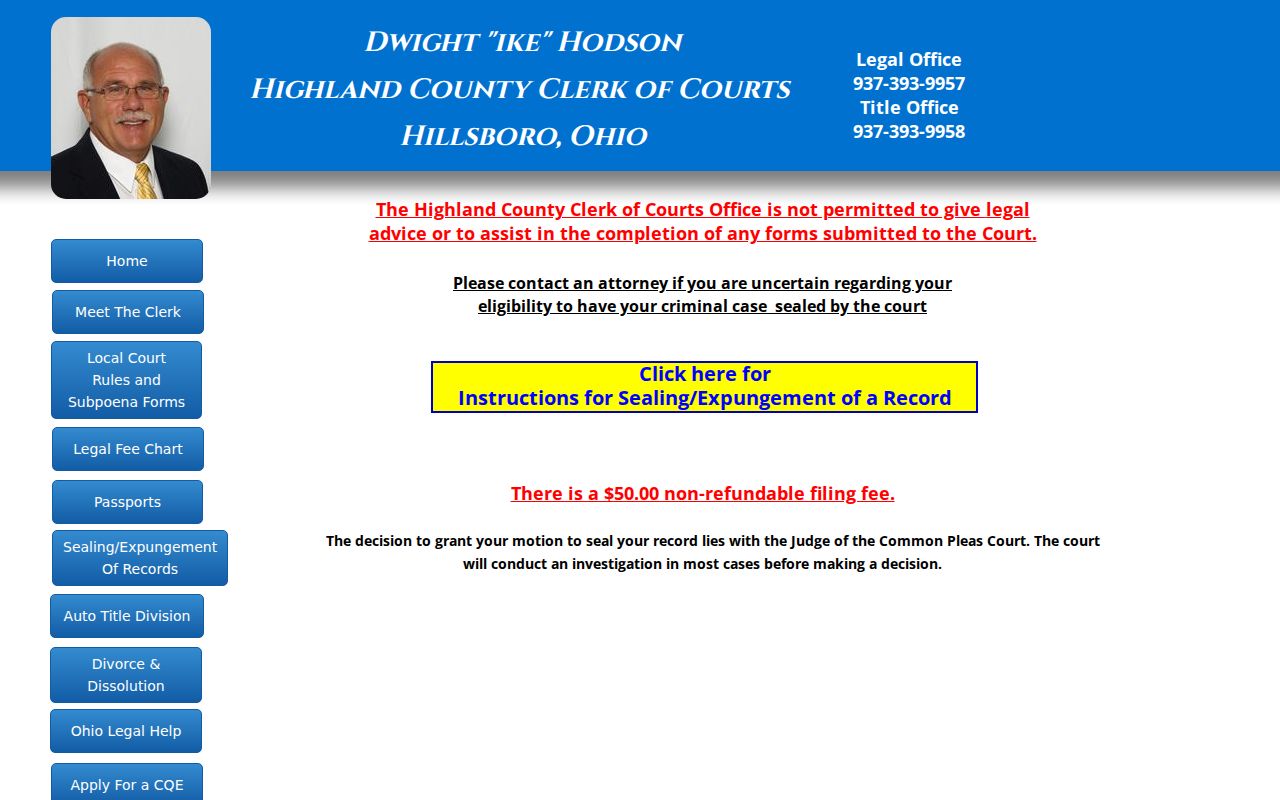
A docket search can find the court event. For an accessible copy or an official certification, the Clerk remains the office to contact.
Criminal Dockets: What They Show
Highland County's official General Division Court Schedule Report lays out its fields. It does so without using a private case as an example. A criminal entry can carry the case number, report and judicial-officer fields, and a case style. It may also show party roles and attorneys, charge number and description, hearing date, time, setting label, and event comments. Give a later court-approved entry more weight. An older notice or a party filing nobody has ruled on yet deserves less. Those calendar fields do not guarantee every item appears on each eAccess case-detail screen. There is no universal display promise for statutory section, bond, financial balance, a download control, or final disposition. Treat the docket as a chronological court index. When the exact ruling matters, read the referenced order through the proper clerk channel.
| Case number | General Division schedule examples use YYCR####, a two-digit year, CR type code, and sequence. |
|---|---|
| Court and officer | The published schedule has a judicial-officer field and a court-report identifier. |
| Charge block | General Division listings include charge number and charge description fields. |
| Setting details | Date, time, setting type, and optional duration or remote-format comments can appear. |
| Documents | The Clerk makes the docket searchable but says document images are not online. |
Highland County Criminal Docket Codes
General Division schedules show Highland County criminal identifiers in the neutral pattern YYCR####. Two digits give the year, CR is the criminal code, then a sequence number follows. The published schedule backs up that visible format. It does not prove every criminal division or historic Highland County docket follows the same sequence. Copy the case number straight from the court notice or docket whenever possible. Then read any court date, charge line, or party role against that same case number. Do not rebuild it from a format example.
Highland County Criminal Docket Split
Felonies in Highland County belong to the Court of Common Pleas, General Division. The Clerk's criminal docket there is its own track. Below that sit the misdemeanor routes. Hillsboro Municipal Court takes traffic and nontraffic misdemeanors plus felony preliminary hearings. That covers all of Highland County except Madison Township. That one township goes instead to Highland County Court, Madison Township Division, sitting in Greenfield. Geography drives the split.
Madison Township cases near Greenfield run through the Highland County Court Record Search. Its CaseLook terms warn that electronic data can lag at least 24 hours. The court posts 937-981-2139 for verified information. Anywhere else in the municipal territory, try the Hillsboro Municipal Court channel. Or call 937-393-3022 when the portal leaves the question open.
| Court route | Criminal docket coverage | Public fallback |
|---|---|---|
| Common Pleas General Division | Felony criminal cases | Clerk eAccess, Clerk legal office, or Common Pleas at 937-393-2422 |
| Hillsboro Municipal Court | Most county traffic, misdemeanor, and preliminary matters | Municipal Court clerk at 130 Homestead Avenue, 937-393-3022 |
| Greenfield County Court | Madison Township traffic, misdemeanor, and preliminary matters | CaseLook, clerk contact, request, or office visit |
Note: A Common Pleas criminal result only covers the felony court. Where a lower-level case arose decides which docket route fits, so check place before searching.
Criminal Case Stages on the Docket
Local Rule 33 lays out the felony timeline for a Highland County Common Pleas case. Arraignment comes as soon as feasible after indictment and service. Served by summons? You can appear in person or by remote video. An arrested person is arraigned by video from the Highland County Justice Center. At that hearing the court or magistrate sets the first pretrial, the final pretrial, and trial dates. The original written notice of appearance goes to the Clerk.
This is why one case can show several future dates at once. They are staged management dates, not duplicate errors. Discovery and pretrial motions come next. Then a plea or trial, disposition, sentencing, and later post-judgment events follow. Rule 33 generally wants trial within 90 days of arraignment. It comes earlier if a speedy-trial deadline demands it. Trial or plea should finish no later than 150 days after arraignment. Sentencing falls within 180 days, subject to the rule's qualifications.
Docket flow: Indictment and service → Arraignment → First pretrial → Final pretrial → Plea or trial → Disposition → Sentencing.
Highland County Criminal Docket Terms
The General Division calendar in Highland County uses setting labels. They beat invented abbreviations. Official reports list pretrial, final pretrial, sentencing, and intervention-in-lieu plea. A label marks a scheduled event only. The result of that event lives in the newest docket entry and any accessible order. Read those for the outcome.
- Arraignment
- An early Common Pleas appearance after service, where Highland's Rule 33 begins the setting chain.
- First pretrial
- The initial criminal case-management setting placed after arraignment.
- Final pretrial
- A later management date before trial or resolution, not a final disposition by its name alone.
- Intervention-in-lieu plea
- A published Highland calendar label for a plea or program step; the later entry determines the legal result.
- Continuance entry
- The court-approved, docketed entry that formally changes a date.
A filed motion to continue does not erase a setting on its own. Rule 33 requires a defendant's continuance request to address speedy-trial rights, and a granted entry must state the extension given. Look for that later approved entry before treating a Highland County court date as moved.
Highland County Criminal Docket Courts
The Highland County Clerk of Courts holds the Common Pleas General Division criminal docket. It also holds Highland-originated Fourth District Court of Appeals records. Future settings appear separately in the Common Pleas calendar page. They arrive through its General Division Court Schedule Reports. Those PDFs can change daily or at the last minute. So check an urgent criminal date against the newest docket or order, and confirm with Common Pleas at 937-393-2422.
Lower criminal records stay with the lower court that owns the case. Hillsboro Municipal Court and Greenfield County Court are distinct dockets, not two names for one. Probate and Juvenile keep separate division records too, and juvenile access follows its own rules. An appeal starts from the originating court's docket. A Highland Common Pleas appeal can spawn a separate Fourth District record within the Clerk's scope.
Highland County Clerk of Courts
Common Pleas criminal records and Highland-originated Fourth District appeals
105 N. High Street, P.O. Box 821, Hillsboro, OH 45133
937-393-9957
Highland County Criminal Docket Appeals
Every Highland County criminal appeal starts with the originating court record. The Highland County Clerk of Courts describes its own role. It covers Highland-generated Fourth District Court of Appeals cases. That appeal record sits apart from the underlying lower-court or Common Pleas docket. Don't stop searching once the trial-court case turns up.
Common Pleas Appendix A lists an $85 filing deposit for a notice of appeal. That is a filing-side deposit, not a price for inspecting the public docket. Confirm the active appeal route and any current fee with the Highland County Clerk. Ask before filing. Or ask before requesting a formal record.
Highland County Criminal Recovery Docket
Highland County's New Way to Recovery Docket is a Common Pleas specialized drug-court docket. It exists by local rule under Ohio Superintendence Rules. An eligible accepted case can be reassigned out of the regular criminal docket. If participation ends unsuccessfully, Rule 33.11 sends the case back onto the judge's regular criminal docket. That is a routing fact, not a separate public search system. It says nothing about any individual's outcome.
The Court's 2025 annual report covers certification. It began in December 2019. Renewals followed in December 2022 and December 2025. It counted 21 active participants. Another 116 were accepted since July 2019, and it counted 61 graduates and 28 unsuccessful terminations at the report date. Sessions are open to the public. They run the second and fourth Friday mornings and afternoons. There is no livestream. The report also describes four phases, an 18-month minimum, and 12 months sober before graduation.
For the rules behind sealing a Highland County criminal record, Ohio's sealing statute is the official text. Specialized dockets and sealed-record rules are separate questions, even when both shape what a public search returns.
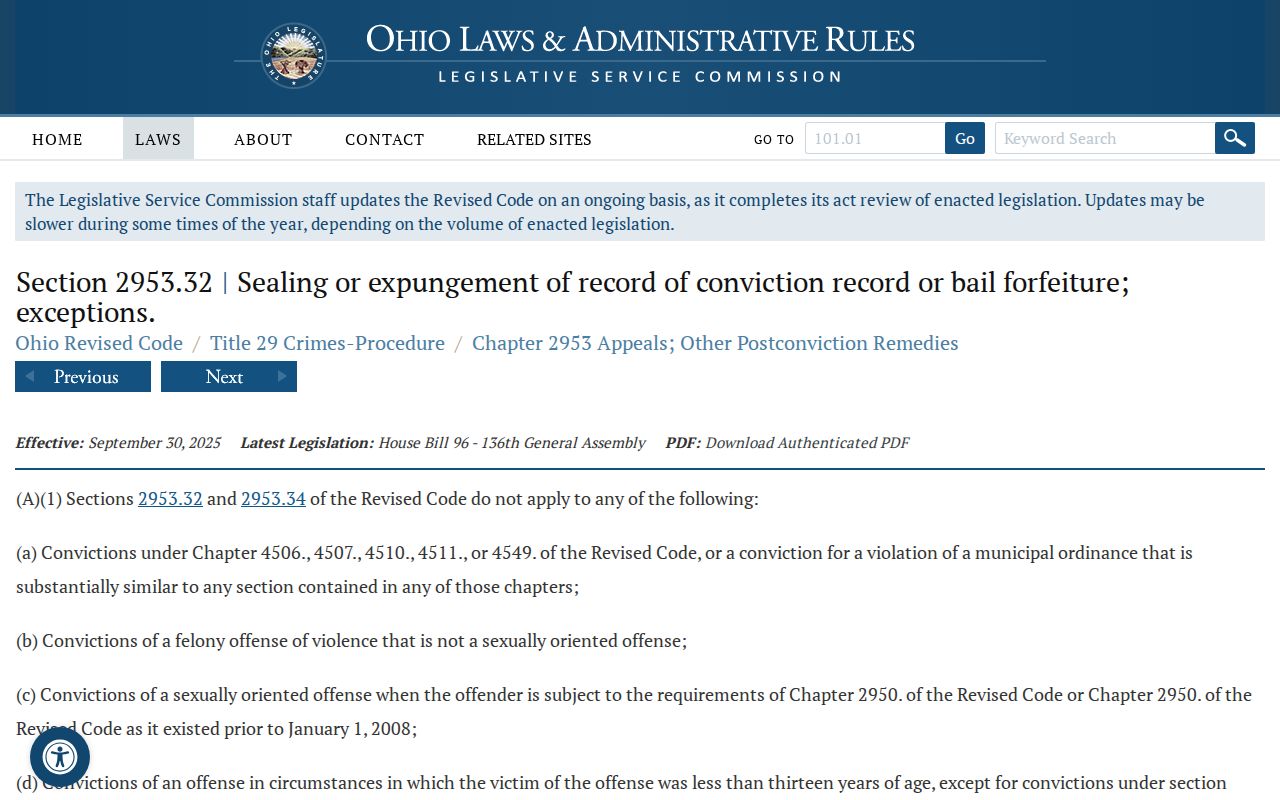
The public calendar and the Clerk's docket still show current court activity. Restricted records stay governed by the controlling court process.
Access Rules for Criminal Dockets
Ohio builds its court-record access rules in layers. The foundation is the Rules of Superintendence 44 through 47. Each court layers its own orders on top. In Highland County, Common Pleas Local Rule 35 presumes filed documents are open unless a rule or law restricts them. Certain categories stay confidential, though, including health, treatment, guardian-ad-litem, financial, and appraisal materials. The searchable Common Pleas docket honors those limits. Nothing about being online turns a restricted filing into a public download.
Sealing works differently. The Clerk's local sealing information lists a $50 nonrefundable filing fee. It also states plainly that Clerk staff cannot give legal advice or help complete a form. Under Ohio Revised Code 2953.32, an eligible person applies to the sentencing court. Statutory conditions still apply. A blank docket search can mean several things. Another court may own the case, or online posting may lag. The name or number may differ, or the file may be confidential. Don't assume an empty result means no case exists. Ask the owning clerk or court.
Access rules: Sup.R. 44-47 supplies Ohio's court-record access framework.
R.C. 2953.32 governs criminal sealing and expungement applications, eligibility timing, and exceptions.
Highland Local Rule 35 identifies locally protected Common Pleas materials and the access-motion process.
Note: A broad county public-records request is not the route here. Court-controlled access is the proper path for a sealed or confidential criminal file.
Highland County Criminal Docket Recordings
A docket entry and a hearing recording are separate products. Local Rule 1 has Common Pleas recording its proceedings digitally. A digital copy of a proceeding costs $5. A typed transcript works differently. It comes through the court reporter or transcription process instead. The online criminal docket supplies neither one on its own.
| Item | Highland County route |
|---|---|
| Public docket event | Clerk eAccess for Common Pleas criminal matters |
| Digital proceeding copy | Common Pleas Rule 1 lists a $5 copy |
| Typed transcript | Arrange through the reporter or transcription process stated by the rule |
Ask the Highland County Clerk which product fits your request. That question matters most when the docket names a hearing but what you actually need is the proceeding itself.
Highland County Criminal Docket Context
Highland County Common Pleas reported 161 new and reopened criminal cases in 2025. That is down from 168 in 2024 and about 22 percent below the five-year average of 206. The report counts a new criminal case as arraignment on an indictment. A reopened case is one previously closed before adjudication. Those definitions leave gaps. Indictments filed but not served are not counted. Nor are bound-over matters still lacking an indictment. Many later proceedings, including probation violations, restitution hearings, sealing, and Drug Court sessions, fall outside the count too.
Treat those court-report figures as context. They are not a tally of every Highland County criminal docket event. A single case can spawn many settings, motions, entries, and court-program appearances, and none of that extra activity shows up in the filing total.
So docket context from Highland County filing numbers will not predict what happens in any one case. The Highland County report follows its own filing definitions. A Highland County criminal docket, meanwhile, records later settings and court action. Those never create a newly counted case.